Showing posts with label gradient. Show all posts

Tuesday, 3 January 2012

Indefinite Integration

  •  Edexcel - C1, Integration
  • AQA - C1, Integration
  • OCR - C2, Integration

We already discussed one of the branches of calculus. The other is Integration, it's general purpose is to find the area between some given intervals. It can be used to find the area bounded by a curve, you will learn this in C2. Right now, we need to know what Indefinite Integration is. It is simply the reverse of Differentiation, if dy/dx is the derivative of some function, we can use integration to obtain the function y. It's also called Anti differentiation. When will integrate some function, we will add a constant c. (The constant of Integration).

That image is the general notation used for Integration. When we integrate, we first draw the S kind of line, then write the function, and then dx. (for now anyway). This shows we are integrating. We need to know how to integrate functions in the form : x^n.

As I said Integration is the reverse of Differentiation. So when we differentiate we multiply the power by the coefficient of the function, and subtract the power by 1. When integrating, we firstly raise the power by 1, and divide by this new power.


a)


      *We usually write c (instead of constant) [  + c ]


I will also post some further examples in my image notes. In my image notes, I will also show you how to derive a the equation of the curve, when given dy/dx and a point on the curve, these question are usually 5/6 easy marks.

With this we end C1 here. I shall start C2 next week... I have done all model solutions for the Edexcel C1 Papers (From Jan 2005 - June 2011), these are available on request. I will start working on the model solutions for Solomon Papers aswell.

Differentiating Functions with Examples and Applications of Differentiation

I will use two examples from the specification itself, which you should be able to differentiate :

1) y= (2x+5)(x-1)
First we expand the brackets, and simplify :

2x^2 - 2x + 5x -5
y = 2x^2 + 3x -5, now we can differentiate so :
dy/dx = 4x + 3

I will show the 2nd example, in my set of image notes.

Application of Differentiation to Equations of Tangents

If we have a curve, and a tangent to some point on the curve. We can find the equation of the tangent. How ?

If we know the coordinates of that point. Firstly we differentiate the curve, and substitute the x-coordinate to get the gradient of the curve at the point. Say, if the tangent is perpendicular to the curve. We know that the gradient of this tangent, will be -1 divided by the gradient of the curve, we just got. Using the gradient, and the coordinates, we can use the y -y1 = m(x-x1) formula to find out the equation.

Example

This question is taken from the Edexcel C1 Jan 2006 Paper. (Question 9)

Sorry for the bad quality
Model Solution 


I have ignored part a).. the rest of the question is more relevant to the post.


Notes on Differentiation with Four Examples
Application of Differentiation for Tangents,Gradients and Normals

Friday, 30 December 2011

Differentiation

  • Edexcel- C1 Differentiation
  • AQA- C1 Differentiation
  • OCR- C1 Differentiation

One of the new topics, we learn in A-Level Maths is Differentiation. It is one of the branches of Calculus, which is a major field in Mathematics, and almost is a useful application in loads of other fields.. Engineering, Economics, Physics and Chemistry. It is concerned with how one thing changes, as a result of another quantity changes. E.g. How displacement changes, as time changes (dd/ dt) would be the velocity.... We shall look for now at how y changes with respect to x (we call this dy/dx) = d (delta which means change)

We will look at curves, where the gradient is changing at each point on the curve. So dy/dx on each point is different, and not constant. First, i'll introduce you to a tangent. A tangent, is a straight line which touches a point on the curve, it only touches that point though.
The green line is the tangent to the curve( in black), this tangent only touches the yellow point on the curve. Note the gradient at the yellow point, is different to the rest of the points on the curve, because the gradient changes as x changes.

The derivative of a curve is the same as the dy/dx of a function e.g.

The derivative of x^3 = 3x^2
dy/dx (x^3) = 3x^2
This is the first derivative, if differentiate again, we would get the second derivative, again.. the third.. and so on..

dy / dx means differentiating y with respect to x. (what is happening to y, as x changes)

How to Differentiate

To differentiate a function, you reduce the power by 1, and multiply by the new power :

Function          Derivative
axn                 anxn-1

e.g. x^2 
dy/dx = 2x


x^3 
dy/dx = 3x^2


* If we had to differentiate anything to the first power e.g. x , 3x, 5x... it would be 1,3 and 5 respectively. Why ? 
Because it is to the power 1, reducing the power to 0.. anything to the power of 0 equals 1 .. so we just multiply the coefficient of x by 1.. which is the same as taking away the x.

*Differentiating a number .. gives 0. Think about it, if draw a graph of say y = 5, the gradient is 0.

Other Notation 

A function can be written as y =... or f(x) = ..., if we have a function defined as f(x) =...., then the derivative of that is f'(x)=...

f(x) = 5x ... f '(x) = 5 (this is called f prime)

*For the first derivative we use one dash.. second derivative two..etc 
We can only differentiate functions in the form of axn    , so if it looks any different, we have to rearrange to get in that form, using rules of indices.


Monday, 26 December 2011

Equation of a Straight Line

  •  Edexcel - C1, Coordinate Geometry
  • AQA - C1, Coordinate Geometry
  • OCR -C1, Coordinate Geometry

Now we move on to Chapter 2, which involves Straight Lines in the x,y plane. As we know we can write linear equations in the form: y =mx + c, where m is the gradient and c is the y-intercept. We can write linear equations in two other forms one is ax + by + c = 0, where a,b,c are real numbers. Also we can rewrite it in the form y - y1 = m(x -x1), where x1,y1 are the x,y coordinates of a point on the line, and m being the gradient.


The latter form will be used a lot, as we need to be able to find the equation of a straight line, when we are given
a) Two points on the line
b) The Gradient and a point

To rearrange from the form y = mx + c, to ax + by + c = 0, is simple. Let's use an example :
If y = 3x + 5, where m =3 and c=5... Rearrange into the ax + by + c form :
3x - y + 5 =0, Done, we took y to the other side.
a = 3, b = -1 , and c=5.

We use this form because when y = mx + c, contains fractions it can look not so concise. This form is better in that respect.

Given two points

When we are given two point, and we need to find the equation of a line through the points. It is fairly simple.
1) First find the gradient of the line
Remember Gradient = dy/ dx (change in y / change in x)
This should give you the m, in the form y= mx +c.

2) Using one the points, use the equation form [  y - y1 = m(x-x1)  ], where x1, and y1 are the x,y coordinates of the point, and m is the gradient.
3) Substitute in the values, and multiply out the brackets, and simplify either in the form y=mx + c OR ax + by + c=0, usually stated in the question.

Example
Find the equation of a straight line through the points (3,7) and (4,10)
1) Find Gradient = (10 -7) / (4- 3)
= 3 /1
=3
m is 3.

2) Use of the points (3,7) or (4,10) and the gradient (3), substitute into the formula : y-y1 = m(x-x1)
Let's use 3,7

y-7 = 3(x-3)  <<Substitute in values
y-7 = 3x - 9   << Expand out
y = 3x - 9 + 7 << Simplify and collect like terms
y = 3x -2  << Equation in the form y = mx + c (m = 3, c = -2)
3x - y - 2 = 0  << Equation in the form ax + by + c   (a=3,  b= -1,  c = -2)

Given the Gradient and a Point

If a given the gradient, and a point its much easier. We just repeat the process using the formula, infact it's the same thing above, but easier, as we don't have to find the gradient. So just plug in the gradient and the coordinates in the formula : y - y1 = m(x- x1)

Perpendicular Lines and Parellel Lines 

* When two lines are parellel, the gradient of the lines is the same. (m)
* When two lines are perpendicular (at right angles), the product of the two gradients is equal to -1 .

Example

a) y = 4x - 3, find the equation of a line which is parellel :
Answer = Any line which has the gradient 4... y=4x + ... the y intercept does not matter.
b) Find the gradient of the line perpendicular :
Answer = Remember the product of the gradients has to be equal to -1.
So Let m be the gradient of the perpendicular line :
m x 4 = -1
m = -1/4


Sunday, 25 December 2011

Transformations of Graphs

  •  Edexcel - C1, Algebra and Functions
  • AQA - C1,Algebra and Functions
  • OCR - C1, Coordinate Geometry and Graphs

In this final post of the first chapter, we will discuss how to transform graphs. Four Transformations can be applied to graphs, and we need to be able to draw the resulting graphs from these transformations.

Transformation 1 - y = af(x)
What you do - Multiply each y coordinate of the graph by a.
How this looks graphically - It either squahes the graph vertically, or stretches it out, depending on a.
** This transformation only affects the y coordinates, the x coordinates stay the same.**

Transformation 2 - y=f(x) + a
What you do - Add a to each of the y coordinate.
How this looks graphically - It shifts the graph upwards by a units.
** Again, this transformation only affects the y-coordinates, and if it is y=f(x) - a, then simply the graph shifts downwards**

Transformation 3 - y=f(ax)
What you do - Divide each x-coordinate by a.
How this looks graphically - It Scales the graph by a factor of 1/a, parellel to the x-axis.
** This transformation only affects the x-coordinates**

Transformation 4 - y=f(x + a)
What you do - Subtract a from each x-coordinate.
How this looks graphically - It shifts the graph to the left by a units.
**This transformation only affects the x-coordinates, if it is y =f(x - a), then the graph will shift to the right by a units.**

I have attached one example with my image notes ! Will post another one tomorrow.

Notes on Transformations of Functions
Example 1

Graphs of Functions and Interpreting Graphs

  •  Edexcel - C1, Algebra and Functions
  • AQA - C1, Algebra
  • OCR - C1,Coordinate Geometry and Graphs

Almost finished with Algebra and Functions, We now need to know how to sketch certain functions, aswell as know how to interpret graphs to solve equations, and know how to apply different transformations (this will be covered in the next post).

In the specification, it says sketching curves defined by simple equations. I shall teach you how to draw linear, quadratic and cubic functions. Though the first two you should have known from gcse. Aswell as teaching you k/x functions where k is a integer (this is a reciprocal function).

Linear Functions


So if you see a function like y=3x + 2, or y= x or y = -4x.... these are known as linear functions, simply because they are straight lines.. and are of the power 1 (exponent). We usually see them in the form y=mx + c, but we will see in the next section Coordinate Geometry, they can be rearranged in the form ax + by + c aswell. Let's focus in the form y= mx + c.

m = gradient of the function (slope)
c = y intercept

If you take y to be 0 : you will get 0 = mx + c, rearrange for x this should be the point on the function when y=0, or where it crosses the x-axis. Likewise if you make x=0, you will get y=c, this is the point on function when x =0, or where it crosses the y-axis.

To plot a function, if you take different values of x and y, you could plot it up... though we are meant to sketch functions in a general way. So Linear Functions are straight lines .. so let's take 3 examples.

a) y= 2x - 5
Firstly we know m = 2 (gradient), and c = -5 (y intercept), this is easy to see in this form, but not all linaer functions are in this form REMEMBER, y= 4x , is still a linear function even though c = 0.

y intecerpt = take x =0, so y= 2(0) - 5
y= -5

We've got a coordinate on the function which is  (0, -5)

x intercept = take y =0, so 0 = 2x - 5 so 5=2x so x = 5/2

Another coordinate is  (5/2 , 0)
As we know it is a straight line just draw a corresponding straight line using the two points :
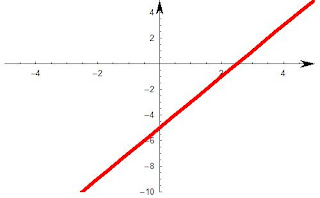
Graph of y=2x-5, notice where it croses the axis, it's just a straight line through the points

b) Let's take y = -6x

Here m = -6 (negative gradient ), and c = 0

y - intercept, y = -6(0), y = 0, so when x =0, y= 0.
First coordinate (0,0)

x- intercept, y =0 so 0 = -6x so 0/-6 = x, so x =0
Second Coordinate (0,0)
As we already knew (0,0) from the first coordinate, the 2nd step was futile.. so we
 simply substitute other values to get a general shape of the graph.

when x = 1, y= -6
when x = -5, y = 30
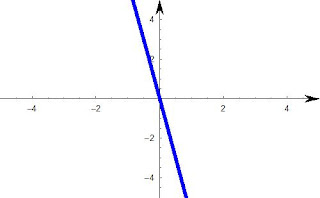
Graph of y = -6x, notice the gradient (m) is negative, so it is downward sloping, and it goes through the origin (0,0).


Quadratic Graphs


As we know from the previous section, that quadratic functions are in the form ax^2 + bx + c = 0. If we have two solutions to the equation (two roots), these are the corresponding x - values where y =0, or the two x intercepts.
We know that a quadratic is a parabola shape, and the coefficient of x squared, determines whether it is a U or a upside down U. If the coefficient is negative, it is an upside down U, if positive it is a U shape. Again we know c is the y intercept ( or where x =0).  There will also be a minimum  or maximum point on the graph, (depending the parabolic nature), this can be found through differentiation (later on...).


e.g. 1 ) y = 2x^2 - 8x + 6

Firstly a =2, so it will be a U shaped parabola shape.
substitute x =0, so y= 6, the y intercept is 6. One coordinate is (0,6)

Now find the roots of the quadratic, (through one of the three methods).
 Let's do it by factorisation, divide everything by 2.

x^2 - 4x + 3 = 0

(x-3)(x-1) = 0
so x=1,3 (these are the points which the function cross the x-axis.

(1,0) and (3,0)
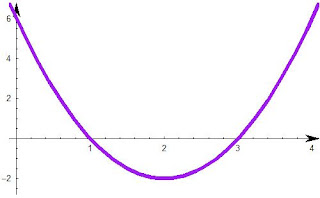
Graph of example above. a) positive a, so U shape parabola, and two roots.

2nd example :
y = -x2 - 4x - 3                                                             

a is -1, so it is an upside down U shape.
y intercept is -3 , (0,-3)

now solve for x :
-x2 - 4x -3 = 0
-(x -1) (x-3) =0
so x =-1 and x = -3

so (-1,0) and (-3,0)
Graph of -x2 - 4x -3, notice where it crosses the axis and the shape.


Cubic Functions

A cubic is in the form ax^3 + bx^2 + cx + d = 0, here again the a decides the shape... we know the cubic shape is a kind of S shape (looking at it with your head tilted). if a is negative then the graph will go from right to left, if positive, then left to right. Here's what i mean :
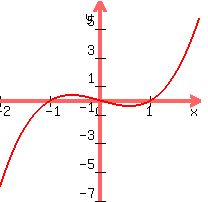
When a is positive
When a is negative
                                
 Again we have to find the x intercepts, by setting the equation equal to 0. And solving, this can be done sometimes if you know one factor, leaving you with a quadratic, which would give you the other two. The y-intercept is found by making x=0.

A cubic will have either 3 roots, 2 roots or 1 root. (it crosses the x-axis 3 times, 2 times or once.)
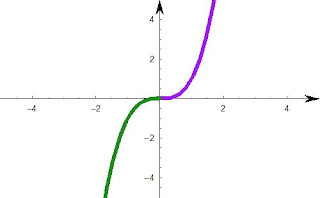
Graph of x^3, notice here there is one root, at the origin (0,0).

 Example 1
y = x(x-2)(x+3)
This is a cubic, but factorised, it we were to expand it, it would give us in the form of ax^3 + bx^2 + cx + d, but when factorised it is easy to draw a cubic. We are only expected to sketch easy cubics at this stage, as solving it, is in C2 (using factor theorem, and algebraic division). If it is already factorised, it is easy to draw... for this example. We have three roots, x=0 , x =2 and x =-3, these are the points where the function cross the x-axis.Remember, so cubics can have two roots, so one may be a repeated root.
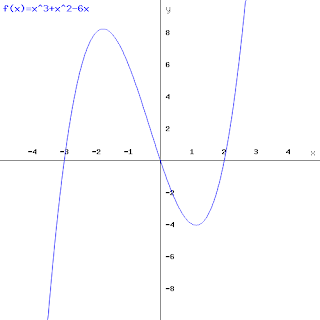
Graph of the cubic (x^3 + x^2 - 6x), when expanded, notice the roots at -3,0 and 2. It has two turning points.

Example 2
x^3 -9x.
Let's try factorising this, if we take x out we get x(x^2 -9). So one root is 0, now we have x^-9. Remember a difference of two square where you have something in the form of x^2 - a. Where a is a square number, if this is the case, the roots of the equation are +root of a and -root of a. In this case a = 9, so the roots are 3 and -3.
All the roots of this cubic are -3, 0 , 3. So we have the coordinates (-3,0)  (0,0) and (3,0). The y intercept is 0.
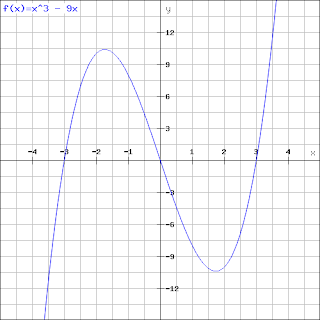
Three roots at 0, -3 and 3.

Reciprocal Graphs
The reciprocal function is y = 1/x. The curve of this function looks like a hyperbola, this is the graph of 1/x :
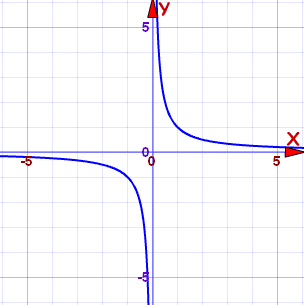
Graph of 1/x
There is one special feature of graphs of the form k/x, where k is some number(and x is not 0). These graphs have a feature called Assymptotes. This graph has two assymptotes, at x=0 and y=0, meaning the graph tends to x=0, and y=0, but never never touches it, thus the shape of the graph. The x-axis is a horizontal assymptote, while the y-axis is a vertical assymptote.

Assymptote - A line where a curve gets closer and closer to but does not meet.
By substituting 0 as x or y, we can find the intercepts of the axes.
If two graphs meet, this algberically, means setting two of the equations equal to each other, the coordinates of intersection, can be found by solving.
A cubic can have one, two or three roots.